
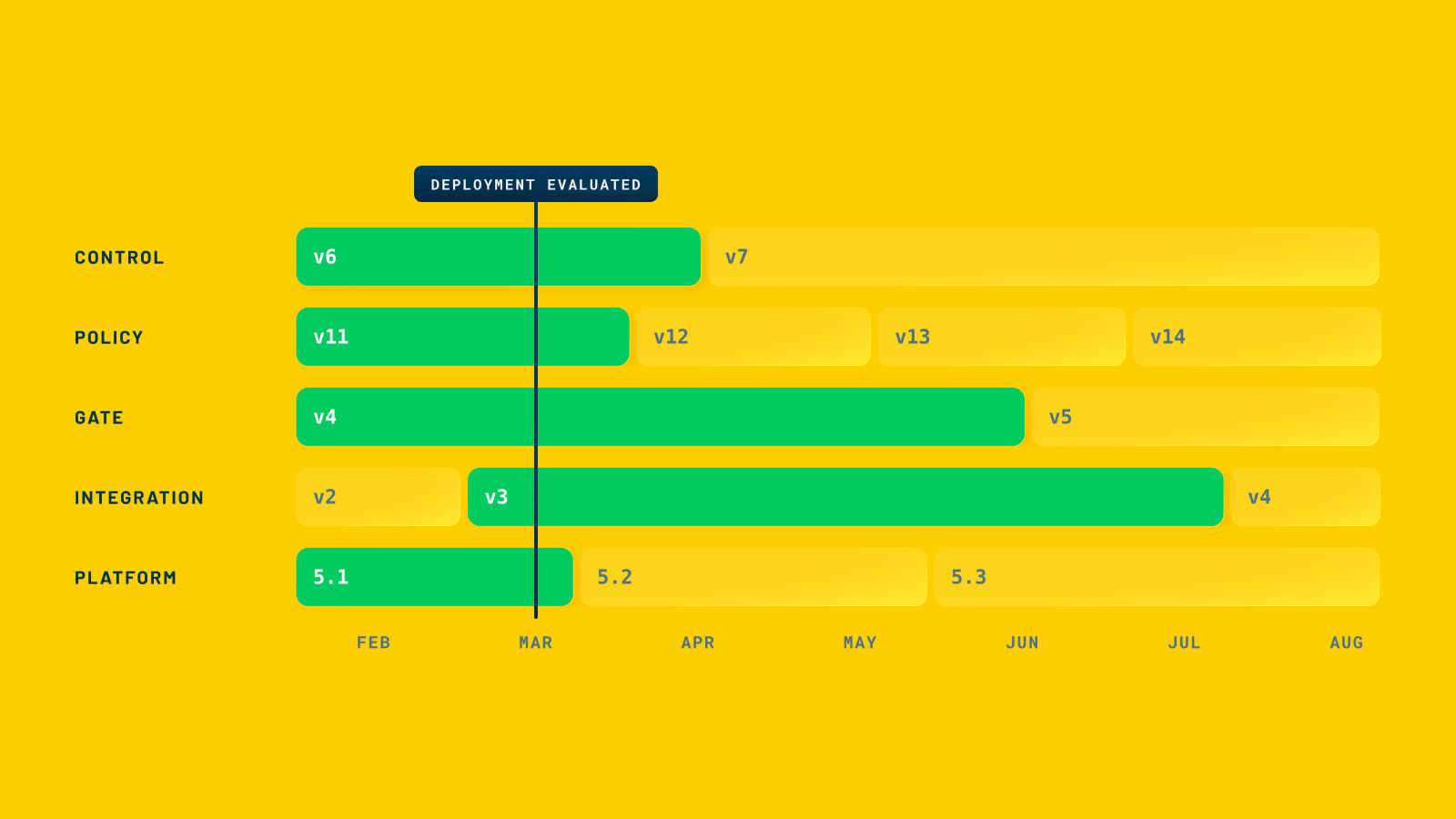
In September, an internal auditor pulls a production deployment from March. The container image that shipped carried a critical vulnerability, and the deployment gate passed it. Today’s policy for that application allows zero critical vulnerabilities, and today’s production gate requires a passing container scan. The auditor asks the question every incident review eventually reaches: how was this allowed to happen?
There are at least five correct answers, and each one points somewhere different. The scanner may not have known about the vulnerability in March. The control may have measured the requirement as it was written then, and the requirement excluded this finding. The policy for that application may have allowed it. An exception may have been in force. The gate for that environment may not have required the scan at all. Each answer has a different owner and a different implication for every other release that shipped that quarter.
A governance platform that preserves evidence without preserving configuration cannot tell these answers apart. It can produce the scan report. The rules that judged the report have changed four times since March, and nothing recorded which version was in force. The investigation turns into archaeology: commit history, change tickets, chat threads, and the memory of whoever was on the team at the time.
This article describes the architecture that makes the question answerable in minutes, with a name and a date attached. It rests on two commitments Fianu makes. Every piece of configuration that contributes to a decision is versioned. Every decision records those versions at the moment it is made.
A decision is evidence plus configuration
Continuous governance is usually described as evidence flowing into policy and decisions flowing out. That description leaves out most of the moving parts. A single gate decision in Fianu depends on all of the following.
| Configuration | What it determines | Why it changes |
|---|---|---|
| Integration version | How a tool’s output was captured and shaped into evidence | The tool’s API or report format changes |
| Control version | The evaluation logic that measures the evidence | Logic is refined or corrected |
| Policy version | The thresholds applied, including layered overrides and exceptions | Risk tolerance changes; an exception is granted or expires |
| Gate version | Which controls must hold, for which assets, at which decision point | A decision point is added or its requirements change |
| Attestation spec version | The schema of the signed record | Fields are added to the record |
| Platform version | The Fianu release that ran the evaluation | Fianu ships a release |
Each row changes on its own schedule, for its own reasons, and is usually owned by a different group. The evidence is the only input fixed at the moment of the event. Everything else moves.
An audit tests whether controls operated as designed during the audit period, which means under the configuration of that period. Proving compliance for a March deployment requires proving what the rules were in March.
This is why the seventh property of trustworthy evidence from our introduction to attestations is the hardest to satisfy: provides sufficient information to reproduce the result. Evidence alone cannot reproduce a result. A scan report with three high vulnerabilities passes under one policy and fails under another. Reproduction requires the evidence and the exact configuration that judged it.
Story on write
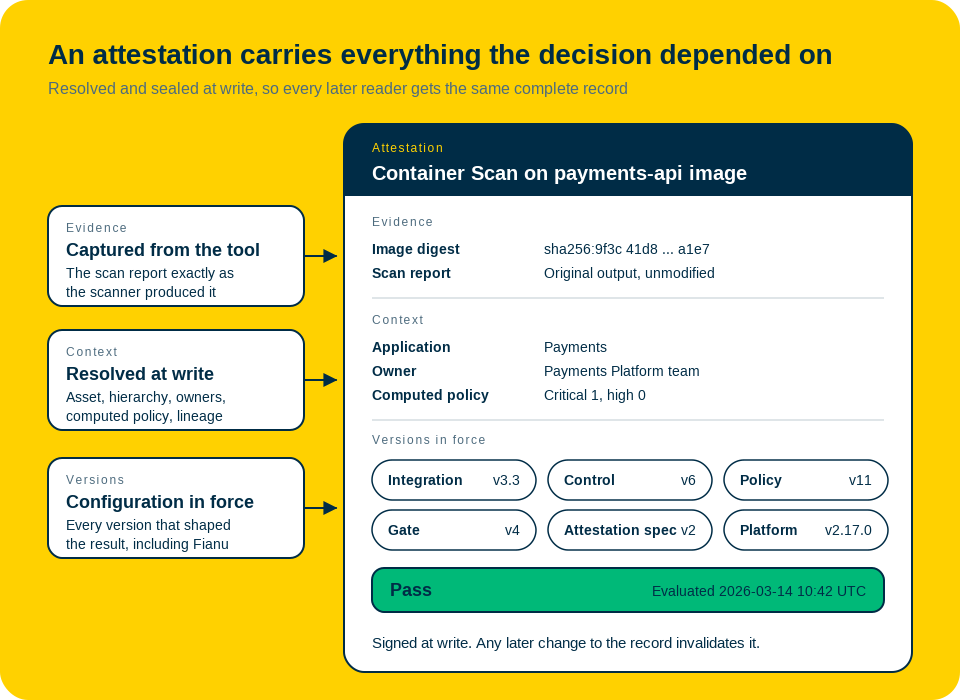
Fianu enriches evidence completely at the moment it is written. We call this story on write. When an event arrives, Fianu resolves the asset it belongs to and that asset’s place in the hierarchy, its owners, the computed policy for that asset, its lineage to related assets, and the version of every configuration in the table above. Controls evaluate the enriched evidence once. The result is written as an attestation, digitally signed, and stored.
The alternative is story on read: store the raw event and reconstruct its context whenever someone asks a question. Because Fianu versions everything, story on read is technically possible on our platform. We chose story on write for four reasons.
A story has to be finished before it can be signed. A signature covers a fixed set of bytes. A story computed at query time exists only for the duration of that query, so there is nothing stable to sign. Story on write produces a complete record at a known moment, and the signature makes that record tamper-evident from then on. This satisfies the rule of authentication described in Part 2 of our governance series: the record is provably what it claims to be, and any later modification invalidates it.
Reads are flat and fast. Reconstructing a historical story requires an as-of join for every piece of configuration: which control version, which policy version, which gate version, and which asset hierarchy were in force at the timestamp of this event. Multiply that by every attestation in an audit period across thousands of repositories and the queries get expensive. They also get fragile. Every author of every query has to get the temporal logic exactly right, and one join against the current policy in place of the historical one returns an answer that is wrong and looks correct. With story on write, a gate decision is a lookup and an audit report is a filter.
Every reader sees the same answer. The developer looking at a failing check on a pull request, the deployment gate, the compliance dashboard, and the auditor’s export all read the same signed record. Under story on read, each consumer’s query is its own interpretation of history, and interpretations drift.
The record stands on its own. An attestation carries its evidence, its context, and its version stamps. It can be handed to an auditor, or attached to an artifact in another system, and verified there without access to Fianu.
Story on write pays its cost once per event, when the event arrives. Story on read pays on every question, and the questions arrive in bursts: the week before an audit, the day after an incident.
Replay: running the judgment again
Story on write records which versions produced a decision. Versioning retains every one of those versions. Together they make replay possible: take the original evidence from the attestation, load the exact integration, control, policy, gate, and attestation spec versions it records, run the evaluation again, and get the identical result.
In Part 2 of our governance series, we cited Lee Loevinger’s distinction between scientific and legal proof. Scientific proof is predictive: a claim holds if others can recreate the conditions and get the same result. Legal proof is postdictive: the conditions of a past event cannot be recreated, so the claim has to stand on the evidence alone. Compliance has always lived in the legal category, because nobody can rerun a build from March.
Replay moves part of compliance into the scientific category. The build still cannot be run again. The evaluation of its evidence can, under conditions recreated exactly. An auditor no longer has to accept a recorded pass on trust, because they can reproduce it.
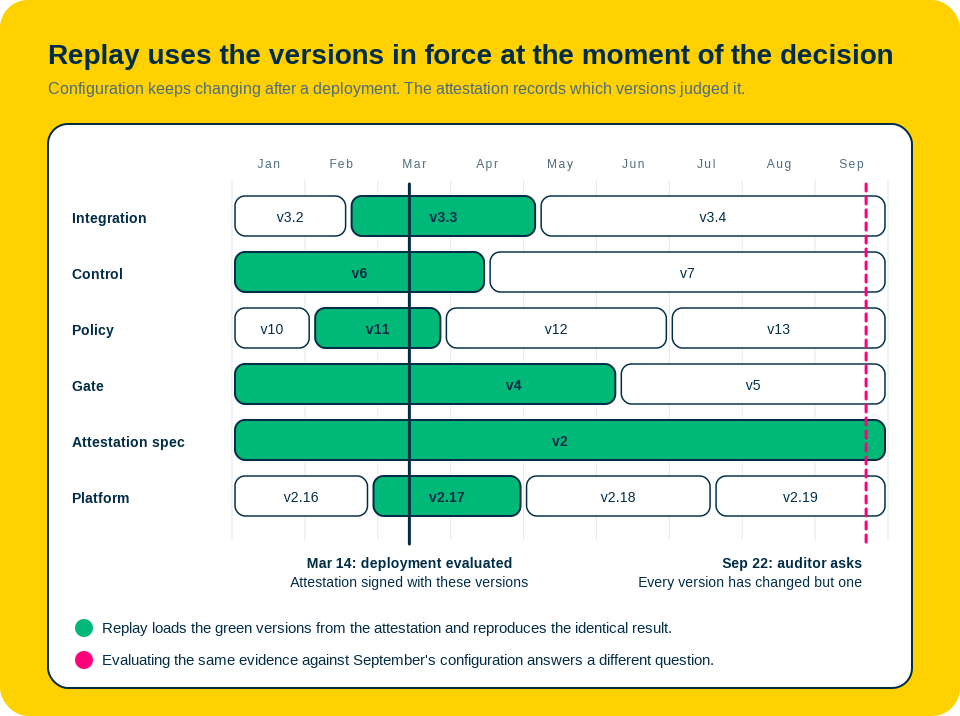
Replay establishes that the recorded decision follows from the evidence and the rules in force at the time. The auditor’s remaining question is what those rules were and who set them, and the version stamps answer it.
How was this allowed to happen?
Return to the March deployment. The auditor replays the gate decision and gets the same pass that was recorded. The version stamps in the attestation now point at the rules that produced it, and each possible answer is a specific record.
Evidence. The scan report preserved in the attestation does not list the vulnerability, because the scanner’s database had not yet published it. Every rule held. The vulnerability was disclosed after the deployment. This is a common answer and a valuable one, because it proves the organization acted on everything that was knowable at the time.
Control. Control version v6 measured the requirement as it was written at the time: critical findings with a fix available. This vulnerability had no fix, so it fell outside the requirement. Version v7 broadened the requirement in April.
Policy. Policy version v11 allowed one critical vulnerability for applications classified as internal, and this application was classified as internal in March.
Exception. An exception was active for that application. In Fianu an exception is a policy, versioned the same way, with an owner, an approver, a justification, and an expiry date.
Gate. Gate version v4 required the container scan control for internet-facing applications only.
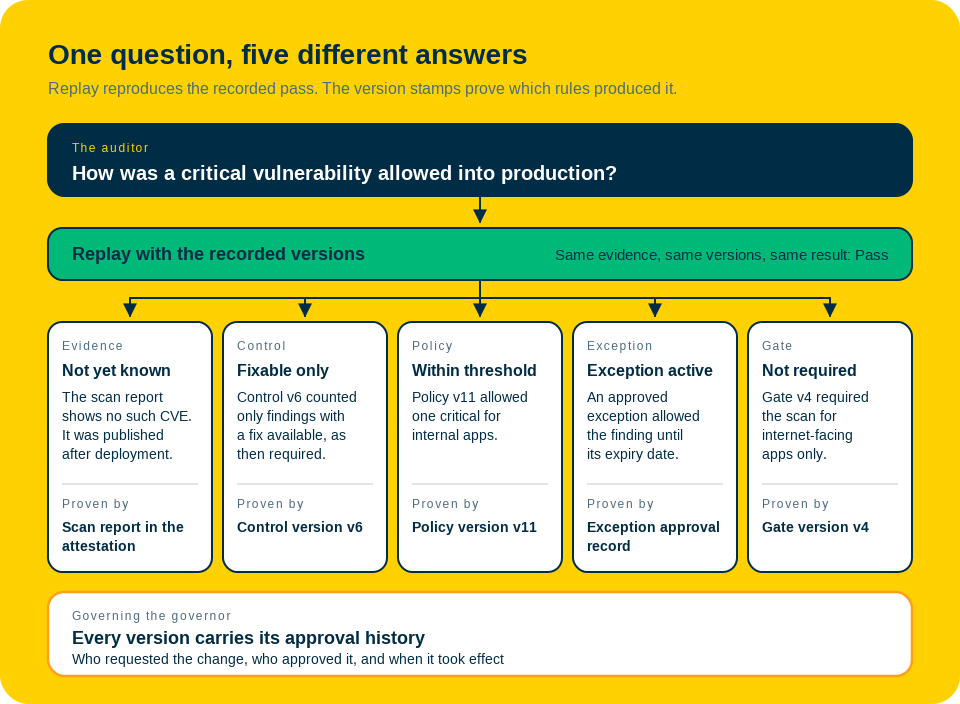
Each answer shows that the release met the rules in force when it shipped, and each names the version of those rules. Every one of those versions was set by someone accountable for it. Without versioned configuration, none of these answers can be proven. The organization is left asserting that the release met the rules of the time, with nothing to show what those rules were.
Governing the governor
The investigation ends with the question auditors always ask next: who changed that configuration, and who approved the change?
A system that decides what reaches production is itself in scope for IT general controls. Auditors will test the governance platform the way they test any system that affects production integrity or financial reporting: who can change a policy, how a change is approved, and whether the history can be produced on request. Separation of duties applies as well. The team whose release is blocked by a policy should not be able to relax that policy on its own authority.
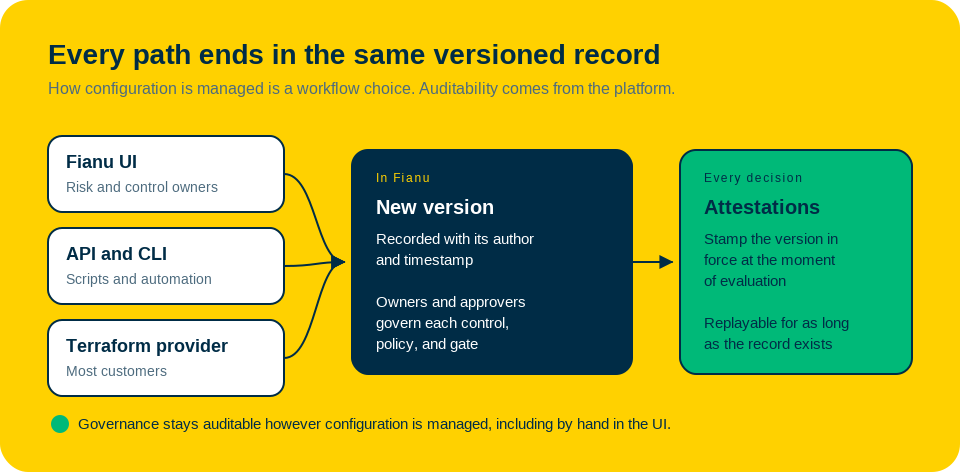
In Fianu, controls, policies, and gates are access-controlled configuration with owners, managers, and approvers. A change is requested, approved by someone with the authority to approve it, and recorded as a new version with its author, approver, and timestamp. The governance layer produces its own change management evidence, the same way it produces evidence for the software it governs. The answer to “how was this allowed to happen” ends with a person, a date, and a documented approval.
Configuration as code becomes a choice
The standard advice for making governance auditable is to manage its configuration as code: keep controls and policies in a repository, review changes in pull requests, and point to the commit history when an auditor asks. Those practices have real value, and they leave a gap.
A repository records what a file said at a given commit. Governance needs to know which version was in force when a specific decision was made, and only the system making the decision can record that, at the moment it makes it. Between a merge and the moment a change takes effect sit apply pipelines, failed applies, drift, and changes made outside the repository. Commit history records intent, and intent is one step removed from the decision.
When the platform versions every configuration natively and stamps every attestation with those versions, governance stays auditable however the configuration is managed, and configuration as code becomes a workflow decision. Fianu configuration can be managed through the UI, the API, the CLI, or our Terraform provider, and most customers choose Terraform. Their reasons are practical. Platform teams already manage infrastructure that way. Bulk changes across many controls and policies are easier to express in code. Pull request review fits how engineers already work. A repository makes the full configuration reproducible from scratch.
A risk owner who does not work in Git can still own and approve a policy in the UI. Every path produces the same versioned record, and every attestation stamps the version that was in force.
Questions to ask of any continuous governance platform
If you are evaluating a platform, or auditing the one you already run, these five questions test whether it can answer “how was this allowed to happen.”
-
Does every decision record the version of every configuration that produced it, including the vendor’s own platform release?
-
Can a historical decision be re-executed with those versions to produce the identical result?
-
Is the record complete and signed at the moment of the decision?
-
Are changes to controls, policies, and gates access-controlled, approved, and versioned inside the platform?
-
Would the platform remain auditable if you stopped managing its configuration as code?
Evidence tells you what happened to a piece of software. Versioned configuration tells you why the organization allowed it. Continuous governance needs both, recorded at the same moment and signed together.