
An auditor samples a production deployment from last March. The attestation for the build says the artifact came from CI job payments-api/release, build 1287, and that static analysis passed. The auditor asks the obvious follow-up: which CI instance, and which static analysis instance?
At a large enterprise, answering that takes real work. A typical organization of that size runs hundreds of CI controllers, four self-hosted static analysis servers plus a cloud tenant that half the portfolio has already moved to, and two GitHub Enterprise Server appliances that are being retired in favor of GitHub Enterprise Cloud. Artifact repositories and security scanners look the same. Build 1287 of a job with that name could have run in dozens of places. If the evidence cannot say which one, the auditor cannot follow it back to its source, and the attestation becomes a claim nobody can check.
This post is about a requirement that rarely shows up on a governance platform’s feature list and that decides whether the platform holds up inside an enterprise toolchain: every piece of evidence must be attributed to the specific instance of the platform that produced it. We cover why enterprises end up running many instances of the same platform, why migrations make the problem permanent, how Fianu separates platforms from tools, and what that separation means for where the record of truth lives.
An enterprise toolchain is many copies of a few platforms
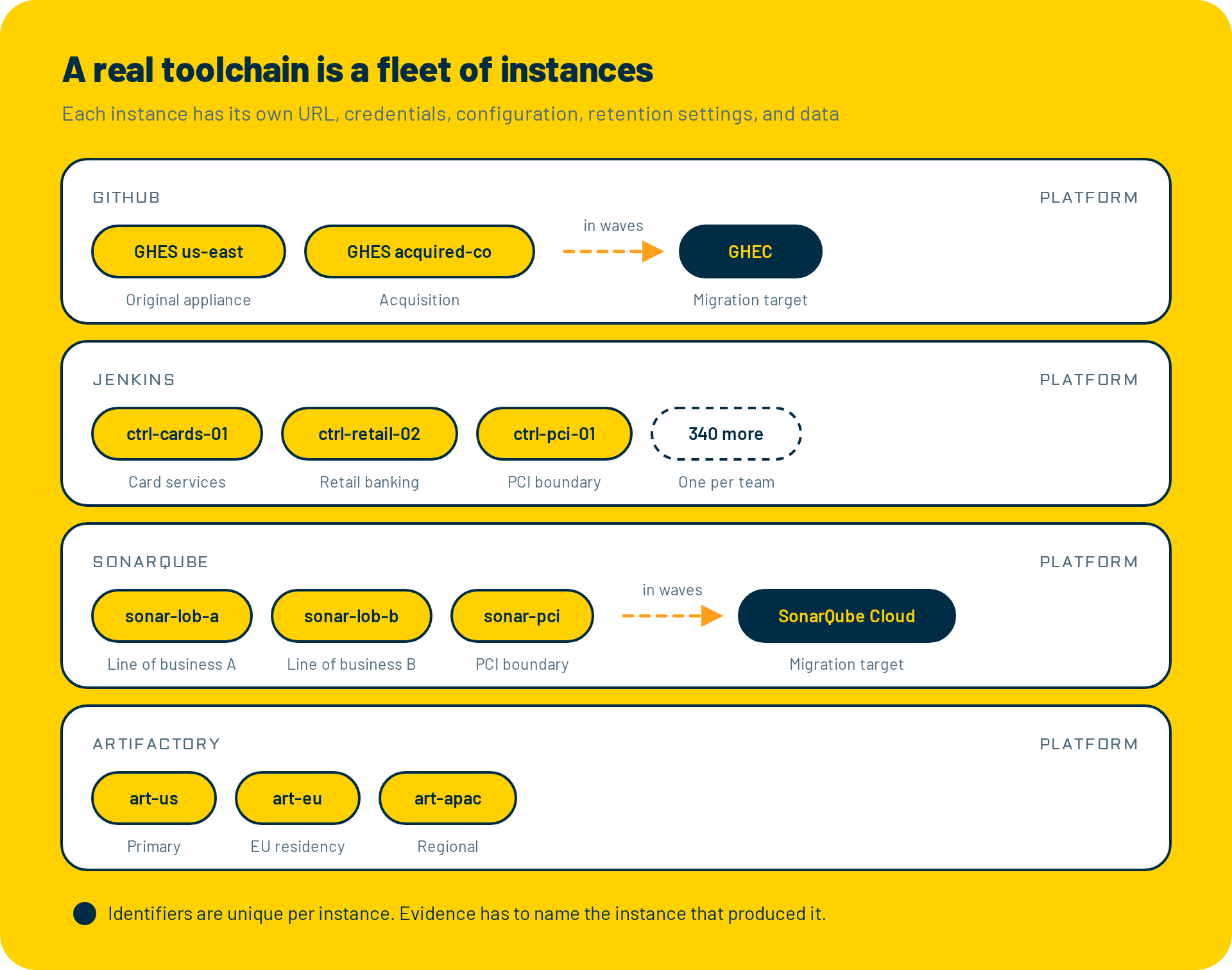
Architecture diagrams show one box per capability: source control, CI, static analysis, artifact repository, security scanning. In a large enterprise, each of those boxes is a fleet of instances of the same platform.
Self-hosted CI shows it most plainly. Take Jenkins: a single controller can only carry so many jobs, executors, and plugins before it becomes slow and fragile, and teams want control over their own plugin sets and upgrade schedules. The result is a controller per team, per business unit, or per portfolio. A large company that uses Jenkins almost certainly runs many controllers (still called masters in most shops), and the largest run thousands.
Every other category of the toolchain follows the same pattern, usually for reasons engineering did not choose.
Acquisitions. Every acquired company arrives with its own source control organization, its own static analysis server, and its own artifact repository. Consolidation takes years when it happens at all.
Regulatory segmentation. Systems that handle cardholder data, government workloads, or other regulated data often have to run on isolated infrastructure. That means a separate instance of every platform inside the boundary.
Data residency. A business unit in the EU may be required to keep source code and scan results in-region, so it runs its own instances.
Scale and blast radius. Artifact repositories and self-hosted source control are commonly split by region or business unit to keep performance predictable and to limit the damage from an outage or a bad upgrade.
Hybrid estates. On-premises instances serve systems that cannot leave the data center. Cloud instances serve everything else.
Each instance has its own URL, credentials, administrators, configuration, retention settings, and data. Two SonarQube servers running the same version are, for governance purposes, two separate sources of evidence.
The fleet is always moving
Enterprises migrate platforms constantly. Some of the most common moves right now are GitHub Enterprise Server to GitHub Enterprise Cloud, SonarQube Server to SonarQube Cloud, and Bitbucket Server to Data Center or Cloud following the end of Server support in February 2024. Consolidations of CI controllers, artifact repositories, and scanner servers happen on top of those.
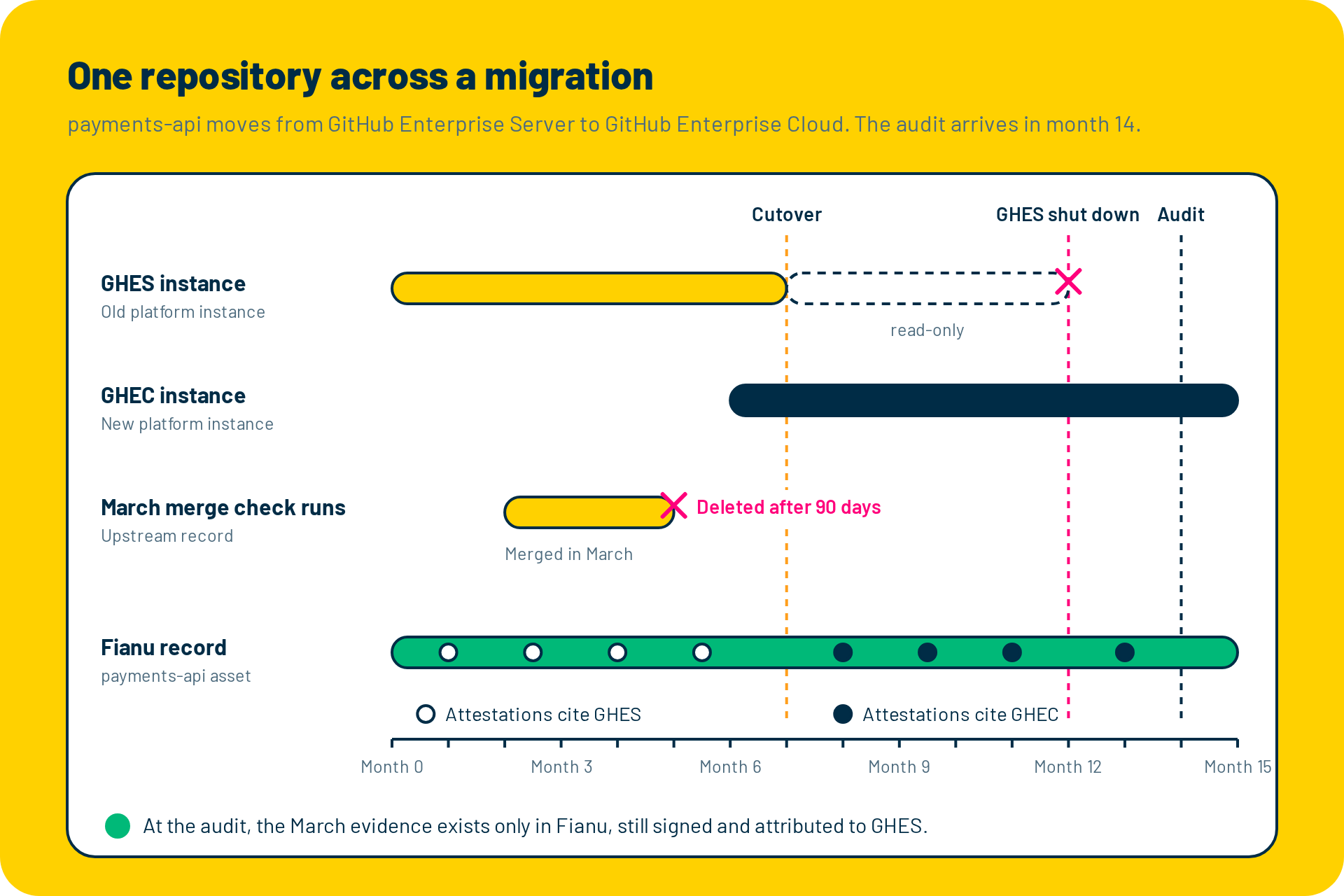
A migration like this lasts months or years. Repositories and projects move in waves. The old and new instances run side by side, sometimes with mirrors between them. One application can have repositories on both instances for most of a year, and one repository can have three quarters of its history on the old instance and the latest quarter on the new one.
For governance, the question “which instance produced this evidence” then has different answers for the same asset depending on the date. A governance platform that assumes one instance per platform will either break at the cutover or, worse, keep working and quietly attribute old evidence to the new instance.
The same name on two instances means two different things
This failure is easy to miss because nothing looks broken.
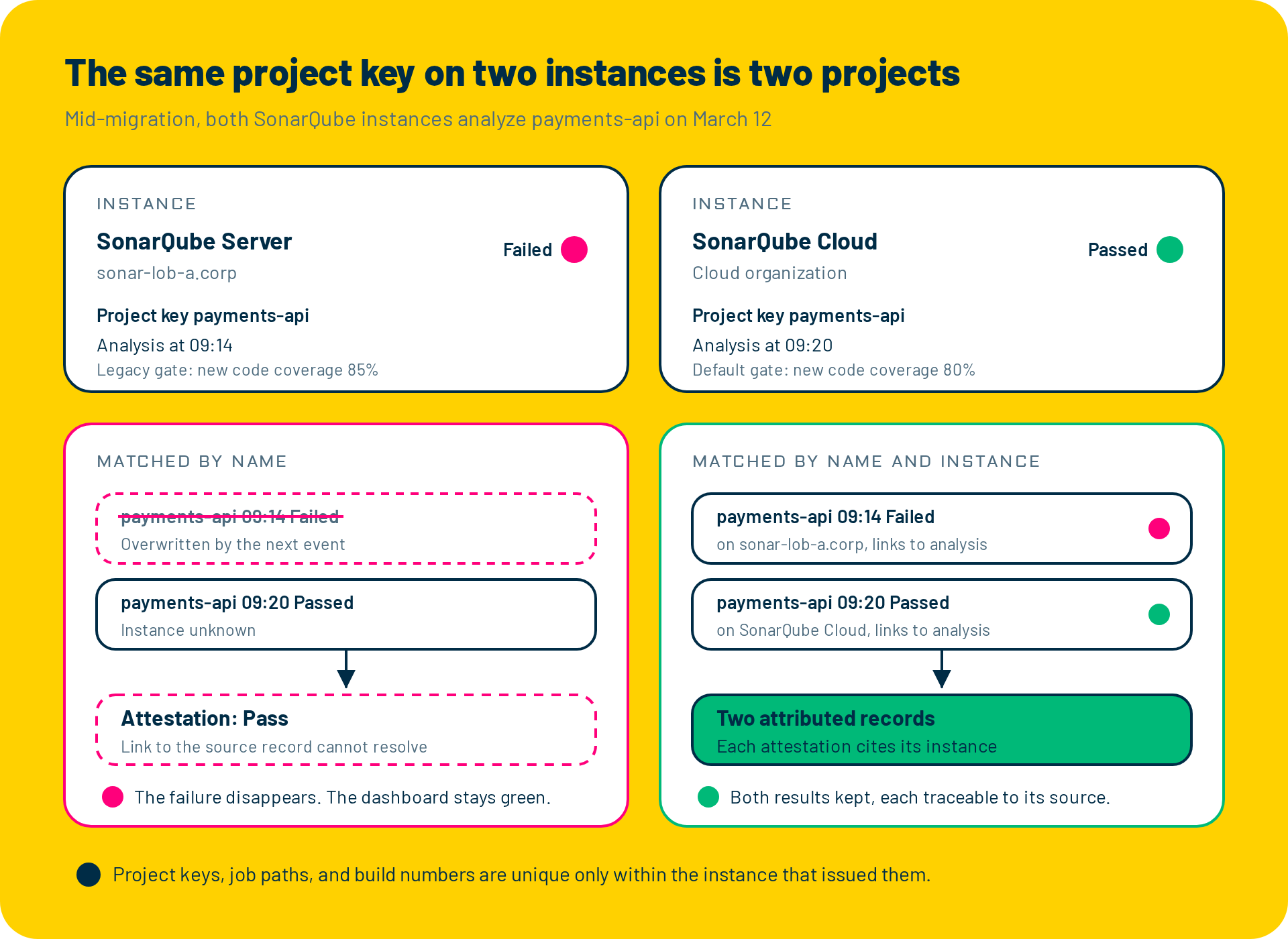
Identifiers in DevOps platforms are almost always unique only within the instance that issued them. A static analysis project key, a CI job path, a build number, a source control organization and repository name, an artifact repository name: each is unique on its own instance and nowhere else. Teams also reuse names on purpose. Standard pipeline templates produce the same job path on every CI instance. A repository migrated to GitHub Enterprise Cloud keeps its organization and name. A SonarQube project usually keeps its key when it moves to SonarQube Cloud.
So payments-api on the legacy SonarQube server and payments-api on SonarQube Cloud are two projects with two histories, two quality gate configurations, and two sets of results. During a migration, both may be analyzing the same code at the same time. Build 1287 of release/main exists on every CI instance that has run that job 1287 times.
A governance system that matches evidence by name alone will do one of two things when it meets this. It will merge events from different instances into one history, or it will let the most recent event overwrite the one before it. Either way the attestation still renders, the dashboard is still green, and the record is wrong. The error surfaces, if it surfaces at all, when an auditor clicks through and lands on a source record that does not match the attestation.
The identity of a piece of evidence has to include the instance that issued it: payments-api on a specific registered SonarQube instance, build 1287 on the specific CI instance that ran it. That attribution has to be captured when the event arrives and signed into the record, because it cannot be reliably reconstructed later.
Platforms and tools
Fianu divides third-party integrations into two kinds, based on one question: does the integration keep its own record of what it did?
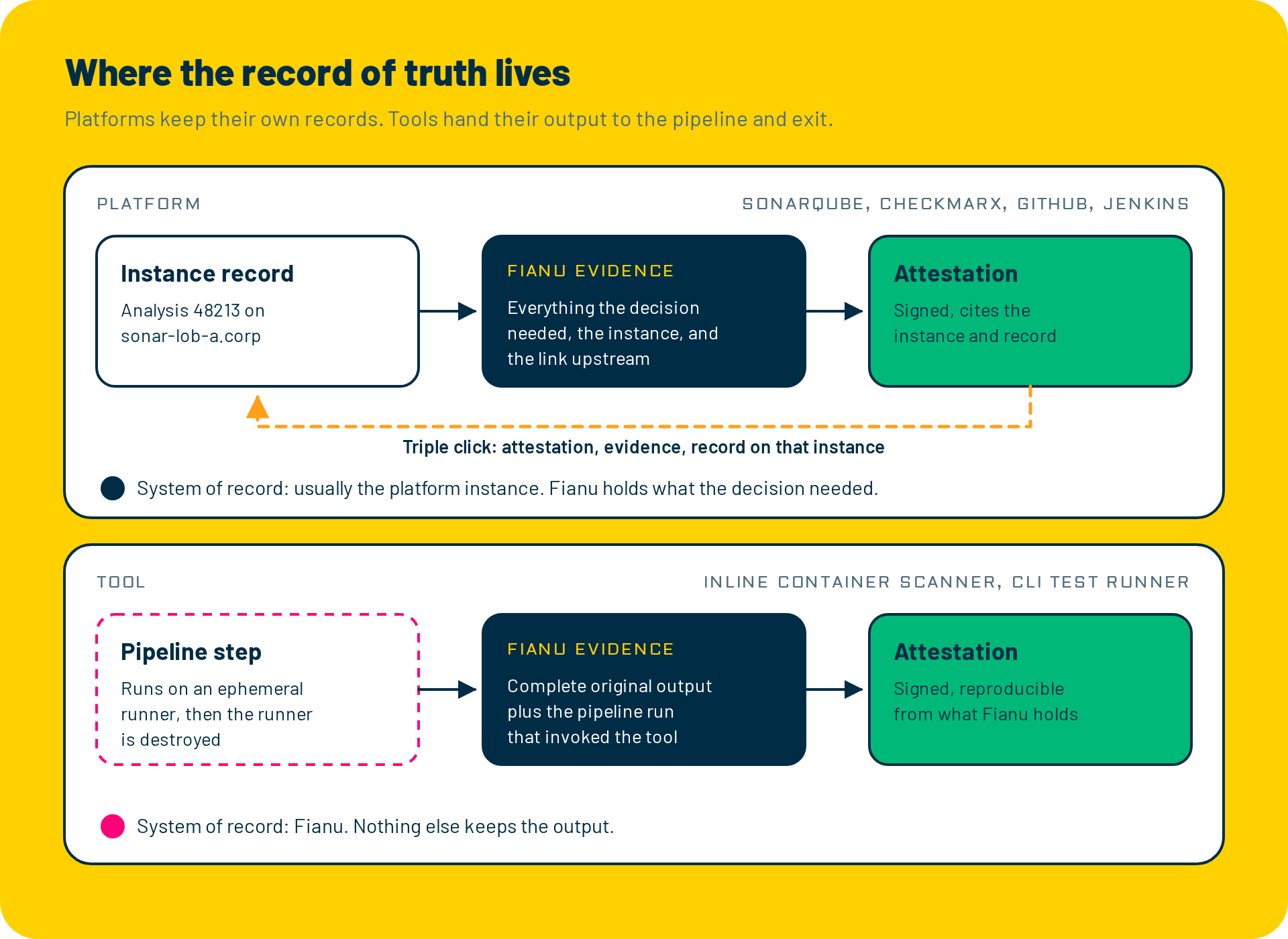
A platform persists data. SonarQube, Checkmarx, GitHub, Jenkins, and Artifactory all store their results, history, and configuration. Because each instance of a platform holds its own data, what exists on one instance does not exist on another. In Fianu, a platform has one or more instances, each registered separately, and every piece of evidence from a platform is attributed to the instance that produced it. A GitHub Enterprise Server appliance and a GitHub Enterprise Cloud enterprise are two instances of the GitHub platform.
A tool does not persist data. An inline container scanner that runs as a pipeline step, a command-line test runner, a linter, a license checker: each produces output, hands it to the pipeline, and exits. Nothing about the run is stored anywhere unless something captures it. Tools have no instances in Fianu’s model because there is no standing system to attribute the evidence to. The evidence is the output itself, together with the context of the pipeline run that invoked the tool.
That distinction decides where the record of truth lives.
Where the system of record lives
For platforms, Fianu can serve as the primary system of record. Most customers prefer to keep the original platform as the system of record, and the preference is sound. The platform is where the event happened, its administrators already know how to operate and defend it, and auditors trust primary sources.
In that arrangement, Fianu’s evidence is everything required to make the pass/fail decision, plus the upstream context that leads back to the primary source. An auditor who has any doubt will want to triple click: from the attestation, to the evidence Fianu evaluated, to the record on the instance that produced it. The last click only works if the evidence knows the instance. It also only works if it points at the specific record (the analysis, the build, the check run), because a project dashboard shows today’s state and the auditor is asking about a past one.
For tools, there is no primary source to click through to. The container scan ran inside a pipeline step on an ephemeral runner, printed its findings, and the runner was destroyed. If Fianu does not keep the output, nobody does. For tools, Fianu is the system of record by necessity, and it retains the complete original output exactly as the tool produced it.
Platforms forget too
The line between platforms and tools is less tidy than it first appears, because platforms do not keep their records forever. Every platform in the toolchain has retention and cleanup behavior, and administrators tune most of it to control storage cost.
GitHub Actions. Starting October 1, 2026, checks, workflow runs, and commit statuses follow the same retention settings as Actions artifacts and logs, with a default of 90 days. Until now those records were kept for 400 days or more regardless of settings, and the change does not restore anything already deleted. For many organizations, the status check proving a required workflow passed before merge will now disappear three months after the merge.
SonarQube. Default housekeeping thins analysis history over time: one snapshot per day after the first day, one per week after a month, one per month after a year, and nothing older than five years. Inactive branches and pull request analyses are deleted after a configurable number of days.
Self-hosted CI. Jenkins jobs, for example, routinely use a build discarder that keeps only the last N builds or the last N days of logs, because controllers run out of disk otherwise.
Artifact repositories. Cleanup policies in Artifactory and similar platforms remove artifacts, and the metadata attached to them, to control storage.
Decommissioning. At the end of every migration, the old instance is shut down, and every record on it goes with it.
Audit and regulatory retention obligations are commonly measured in years. The upstream record will often be gone before anyone asks for it.
This is why Fianu retains everything the pass/fail decision depended on, including for platforms the customer treats as the system of record. While the upstream record exists, the triple click corroborates the attestation. After it is gone, the attestation, the signed evidence behind it, and the instance attribution still show what was evaluated, where it came from, which policy applied, and what the result was. The decision can still be reproduced from what Fianu holds.
Migrations without a break in the record
Instance attribution is also what lets an asset move between instances cleanly.
In Fianu, a repository that moves from GitHub Enterprise Server to GitHub Enterprise Cloud remains the same asset with one continuous compliance history. Attestations issued before the cutover cite the old instance. Attestations issued after it cite the new one. Policies, exceptions, ownership, and release history stay with the asset, because they were attached to the asset all along.
This depends on how controls are defined. Fianu controls describe requirements and are named for them: Static Code Analysis, Code Review, Software Composition Analysis. They are deliberately vendor-neutral. When a customer moves from SonarQube Server to SonarQube Cloud, the Static Code Analysis control and its policy stay the same. The instance supplying the evidence changes, and the record shows exactly when that happened for each asset.
The two shortcuts both fail. A system that ties asset identity to the instance treats the migrated repository as a new asset and starts its history from zero. A system that ignores instances keeps the history continuous but blends evidence from both instances, so nobody can tell which record came from where. Neither holds up in an audit of the migration period, and that is the period auditors care most about, because periods of change are where controls tend to break down.
Questions to ask of any continuous governance platform
For platform engineering and DevOps leaders evaluating how governance will hold up across their estate, these questions test whether a system was built for the way enterprise toolchains actually look.
-
Can you register many instances of the same platform, each with its own credentials, network path, and owner?
-
Is every piece of evidence attributed to the instance that produced it, and is that attribution captured at ingest and signed into the record?
-
When two instances use the same project key, job path, or repository name, do their records stay separate?
-
Does an asset keep its identity, history, policies, and exceptions when it moves from one instance to another?
-
Does each attestation link to the specific record on the specific instance, such as the analysis, build, or check run?
-
If the upstream record is removed by retention or the instance is decommissioned, can the pass/fail decision still be reproduced from what the governance platform holds?
-
For tools that keep no record of their own, does the governance platform retain the complete original output?
Continuous governance is judged in the audit, months after the event, against a toolchain that has changed in the meantime. The evidence has to say what happened, to which asset, under which policy, and on which instance of which platform. The instance is what connects the attestation to its source.